Connect with the Archives for your research needs!
|
Email research@winonahistory.org
or call 507.454.2723 ext. 2 to make a research appointment. Admission is $5 for adults, $3 Students and FREE for WCHS members, Students doing research for a class, and children 7 and younger. (Other fees may apply) Looking to pay your archive fees? Press the "Pay Here" button below.
|
|
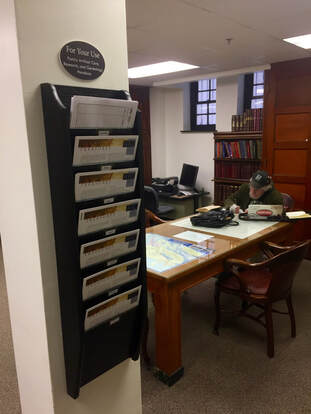
Recognized as one of the finest local archives in Minnesota, the Laird Lucas Library and Archives contains irreplaceable collections of manuscripts, documents and photographs. Professional historians, students and family researchers find this outstanding facility a valuable resource to fill their needs for research, study and information. We can provide you with information on how to trace your family tree or assist you with research in most areas of local history.
The Archives are located on the lower level of the Winona County History Center.
The Archives are located on the lower level of the Winona County History Center.
Please be aware that our staff and volunteers spend many hours researching, identifying, cataloging, and digitizing our collection. We are happy to share these collections with the public, but there is a monetary value to our storage facilities, equipment, and time. We hope you understand the fees we ask of you, and if these are prohibitive for your project, please let us know.
Download and print the Archives Pricing Menu:

| archivespricingmenu.pdf |
Using Archives Resources
Stacks are closed to the public, so staff archivists will bring materials to researchers as requested and can help researchers identify potentially useful sources within the library and archives. Microfilm reader-printers may be used with newspaper and census records stored on microfilm reels. Wi-Fi, and a public computer with Internet access are also available for use. No personal scanners are allowed and the library and archives is non-lending.
The permission to use an image or other media from the collections of the Winona County Historical Society is granted if the following conditions are met. Possession of an WCHS image or reproduction in any form does not constitute the permission to use it. Permission must be requested in writing.
A great way to get started on your local Winona County research:
- The Winona Newspaper Project allows you to search Winona Newspapers online! You can even wear your pajamas!
More Resources:
- Archives at home! Tips for keeping your family records and treasures in good shape for generations
- MNopedia An online encyclopedia of Minnesota topics from the Minnesota Historical Society
- Digital Collections Explore our Huntley and Tenney image collections and more at Minnesota Reflections
- Genealogy & Family Research Find a ton of tools and tutorials from the National Archives
- Free Genealogy Resources from American Ancestors
The permission to use an image or other media from the collections of the Winona County Historical Society is granted if the following conditions are met. Possession of an WCHS image or reproduction in any form does not constitute the permission to use it. Permission must be requested in writing.
- Permission is for one-time, one-media, or one-project use only. WCHS retains all rights to the images and material. They may not be used for any other purpose than that listed on this form.
- Requestor must pay any required use fee (see Use Fees below) when submitting the Request for Permission to Publish form.
- Credit must be given to the WCHS and the creator of the work, if known. Credit should read: Courtesy of Winona County Historical Society.
- Credit must appear with the image, on a credit page that indicates the page number and position on the page, or in the case of a moving image or audio clip captioned to include the correct title and credit with the footage or at the end of film.
- If the image is still under copyright and the copyright is not held by WCHS, the Requestor must seek permission from the creator of the work or from the current copyright holder.
- WCHS assumes no responsibility for infraction of copyright laws, invasion of privacy, or any other improper or illegal use that may arise from reproduction of any image.
- Photographs may be cropped to suit design and layout but may not be altered in any other way without specific written permission.
- WCHS reserves the right to require a copy of the publication, production, broadcast, or compiled, finished work as part of this use agreement. Send the copy to: WCHS, 160 Johnson St., Winona, MN 55987.
- WCHS requests that all attempts are made to represent the history of the reproduction as accurately as possible and bring any question to our staff for verification prior to publication.
- WCHS reserves the right to decline permission to anyone who has not complied with the above conditions.
A great way to get started on your local Winona County research:
- The Winona Newspaper Project allows you to search Winona Newspapers online! You can even wear your pajamas!
More Resources:
- Archives at home! Tips for keeping your family records and treasures in good shape for generations
- MNopedia An online encyclopedia of Minnesota topics from the Minnesota Historical Society
- Digital Collections Explore our Huntley and Tenney image collections and more at Minnesota Reflections
- Genealogy & Family Research Find a ton of tools and tutorials from the National Archives
- Free Genealogy Resources from American Ancestors
Laird Lucas, 1922 - 1975
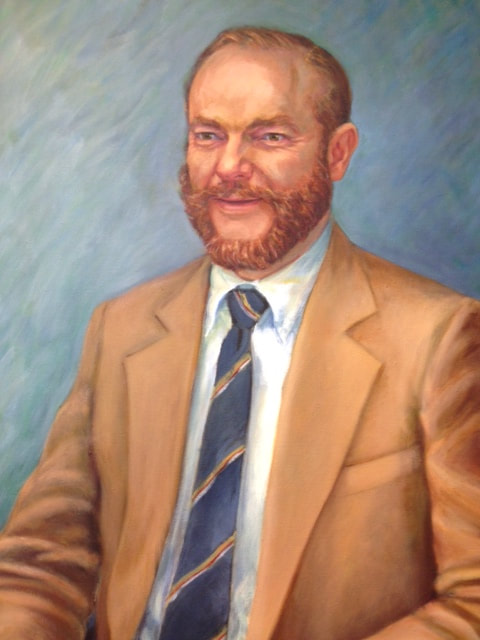
Portrait of Laird Lucas, by E.M. Thomas, 1979.
The generosity of the Lucas family enabled the Winona County Historical Society to establish and develop the Laird Lucas Memorial Library and Archives. Today, it is one of the best local research facilities in the Midwest and continues to grow. Laird was very active in the Winona community, serving on boards of numerous charitable and fraternal organizations. He was vice-president of Laird, Norton & Co. and United Building Centers. In 1942 Laird entered the U.S. Army after attending Dartmouth College. As a lieutenant he was wounded three times, assisted in the action capturing Remagen Bridge, and was awarded the Purple Heart with clusters and the Silver Star.